
Finding the Best Office Coffee Machine Supplies requires auditing your workplace’s daily beverage consumption, verifying ingredient compatibility with your equipment, and securing high-reliability wholesale distributors. Choosing the correct consumables—such as specialty whole beans, soluble dairy powders, eco-friendly cups, and dedicated descaling agents—directly impacts equipment longevity and beverage quality.
Understanding the Office Coffee Supply Ecosystem
The office coffee supply ecosystem comprises all raw ingredients, disposable service products, water treatment cartridges, and sanitation chemicals necessary to operate workplace brewing equipment. Securing a reliable supply chain prevents morning downtime, maintains beverage consistency, and protects mechanical components from premature wear.
A high-performing coffee program relies on four interdependent pillars: premium raw ingredients, durable paper and plastic disposables, preventive maintenance chemicals, and ergonomic storage solutions. Neglecting any single component leads to degraded drink quality or costly mechanical failure.
Core Categories of Office Coffee Consumables
Office coffee consumables are divided into four primary functional groups that sustain daily beverage operations across corporate breakrooms.
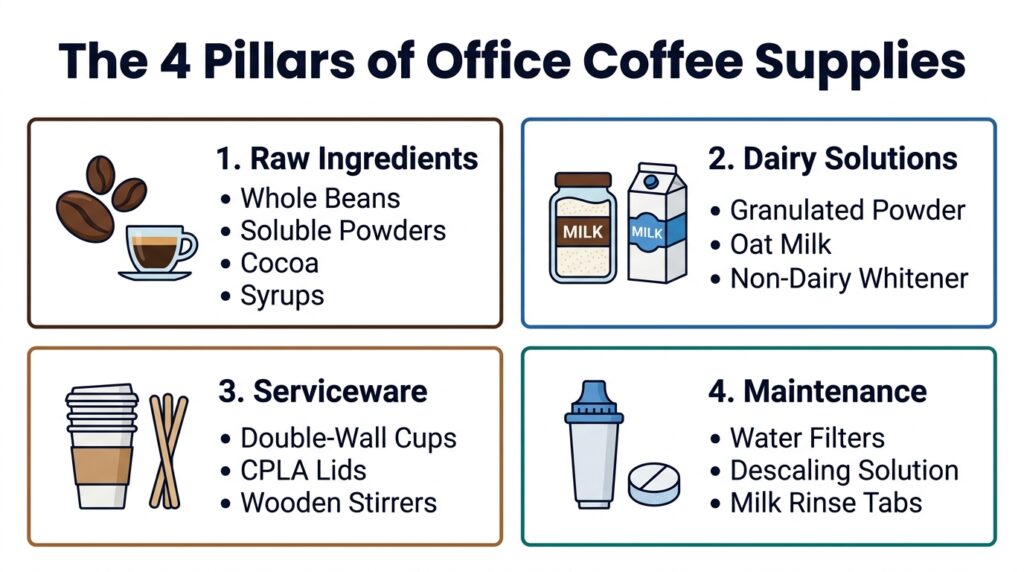
- Raw Ingredients: Whole coffee beans, pre-ground roast batches, freeze-dried soluble instant powders, cocoa mixes, and soluble topping powders.
- Liquid & Powdered Dairy: Fresh milk, shelf-stable liquid creamers, non-dairy whiteners, and micro-granulated milk powders engineered for automated hoppers.
- Serviceware Disposables: Double-walled paper cups, compostable lids, wooden stirrers, napkins, and condiment organizer trays.
- Maintenance & Sanitation Supplies: Alkaline line cleaners, citric acid descaling solutions, milk line rinse tabs, and inline water filter cartridges.
Supply Requirements by Machine Type
Equipment architecture determines the exact formulation and particle size of the supplies required for seamless extraction. Using improper ingredients—such as oily espresso beans in automatic hoppers or non-agglomerated milk powders—causes line blockages and pump failure.
| Equipment Architecture | Primary Consumable Format | Required Ingredient Specification | Common Supply Risks |
| Bean-to-Cup Machines | Whole Coffee Beans, Granulated Milk | Medium roast, low oil surface density, 100% agglomerated powder | Oily beans clogging internal burr grinders |
| Soluble Vending Machines | Instant Coffee Powders, Topping Mixes | High-solubility spray-dried or freeze-dried particles | Moisture absorption causing powder caking in canisters |
| Liquid Concentrate Systems | Bag-in-Box (BIB) Coffee Extract | Ambient or refrigerated shelf-stable liquid concentrates | Mold growth in unsterilized dispense tubing |
| Pod & Capsule Systems | Single-Serve Aluminum/Plastic Pods | Nitrogen-flushed, oxygen-barrier sealed single portions | High per-cup waste and storage volume overhead |
Understanding these distinctions helps office managers avoid costly operational mistakes when reordering monthly inventory from a specialized coffee vending machine supplier.
Strategic Criteria for Evaluating Coffee Machine Suppliers
Evaluating coffee machine suppliers requires assessing their product range, fulfillment speed, wholesale margin structures, and emergency service guarantees. Partnering with the wrong vendor results in stockouts, inconsistent roast profiles, and inflated operating costs per cup.
Supplier Reliability and Sourcing Transparency
Supplier reliability is measured by order fulfillment accuracy, batch-to-batch roast consistency, and lead-time stability. High-caliber vendors provide clear lot tracking, single-origin or blend transparency, and guaranteed roast dates within 14 days of dispatch.
Direct sourcing transparency ensures that whole beans retain volatile aromatic compounds before delivery. Suppliers using nitrogen-flushed valve bags prevent oxidation, extending fresh flavor stability up to six months in breakroom storage.
Wholesale Pricing Structure vs. Per-Cup Economics
Wholesale pricing structures should be evaluated on a per-cup net cost rather than the initial bulk purchase price per kilogram or case. High-density commercial powders and concentrated whole beans yield more dispenses per unit weight, offsetting higher upfront tag prices.
Procurement Rule: Calculate supplier value using total cost of ownership (TCO). A $15/kg coffee bean delivering 140 cups ($0.107/cup) is more economical than a $12/kg bean delivering 90 cups ($0.133/cup) due to lower extraction efficiency.
Ingredient Freshness and Packaging Integrity
Ingredient packaging must feature multi-layer aluminum barrier films, one-way degassing valves, and moisture-proof resealable zippers. Exposure to humidity and oxygen degrades soluble powders into solid blocks and turns coffee fats rancid.
High-grade packaging preserves ingredient integrity during seasonal humidity shifts. Inspect supplier packaging certifications to ensure compliance with FDA food-contact standards before signing recurring fulfillment agreements.
Matching Machinery with Optimal Consumable Supplies
Selecting compatible consumable supplies requires matching ingredient characteristics directly to your machine’s brewing assembly and volume rating. Over-specifying or under-specifying supplies reduces beverage quality and strains mechanical components.
When auditing workplace needs, consult an expert guide to purchase office coffee machine options to ensure your hardware matches employee headcounts and usage patterns.
Small Workplace Solutions: Premium Countertop Machines
Small offices with 10 to 30 employees require compact equipment that delivers café-quality espresso without demanding intensive daily maintenance. These environments thrive on bean-to-cup systems with integrated hoppers and intuitive touchscreens.
The Premium Countertop Touch Screen Coffee Machine delivers exceptional single-touch espresso and specialty beverages for boutique offices. Pair this unit with medium-roast Arabica beans and premium agglomerated dairy powders to keep maintenance fast and simple.
- Ideal Daily Output: 30 to 70 cups.
- Best Supply Match: Low-oil Arabica espresso beans, 100% skimmed granulated milk powder, 8oz double-wall paper cups.
- Footprint Efficiency: Fits standard breakroom countertops without custom plumbing retrofits.
Medium-Scale Enterprise Deployments: High-Capacity Espresso Platforms
Medium-sized corporate floors with 30 to 100 staff members require robust espresso platforms capable of handling consecutive morning rushes without thermal drop or bean hopper depletion.
Deploying the Pro Coffee Vending Machine ensures steady throughput with dual bean hoppers and dual soluble canisters. This setup allows offices to offer dark roast espresso, light roast drip coffee, hot chocolate, and chai lattes simultaneously.
- Ideal Daily Output: 80 to 200 cups.
- Best Supply Match: High-density espresso roasts, high-solubility cocoa powders, eco-friendly 10oz paper cups.
- Key Operational Feature: High-volume internal waste grounds bins reduce manual emptying cycles to once daily.
High-Volume Commercial Hubs: Industrial Automated Units
High-density corporate headquarters, hospital break rooms, and university campuses with 100+ daily users demand heavy-duty, high-capacity automated beverage stations.
The CorePro Coffee Vending Machine provides maximum output, rapid dispense speeds, and seamless integration with corporate payment systems. Pair it with commercial-grade bulk supplies to maintain uninterrupted service during peak hours.
For comprehensive enterprise fleets, browse the complete catalog of commercial coffee vending machines to compare throughput ratings and canister configurations.
Specialty Beverage Stations: Cold Brew and Iced Dispensing
Modern workplaces increasingly demand iced coffee and cold-brewed beverages year-round to retain younger talent and improve workplace satisfaction. Offering cold drinks boosts employee engagement and reduces afternoon trips to off-site cafes.
Integrating an Iced Coffee Vending Machine expands breakroom capabilities by delivering chilled, flash-brewed coffee and iced lattes. This unit requires specialized flash-soluble coffee bases, liquid syrup concentrates, and heavy-duty clear PLA cups.
Proper placement is essential for maximizing usage. Check optimal placement strategies in this breakdown of the best location to place office coffee machine hardware.
Essential Office Coffee Supplies Breakdown
Operating a corporate beverage station requires maintaining an itemized inventory of ingredients, serviceware, and sanitation chemicals. Skimping on ingredient quality or skipping routine cleaning supplies inevitably leads to machine failure and poor cup taste.
For detailed reordering metrics, review this comprehensive guide on coffee vending machine supplies.
Whole Bean, Ground, and Soluble Coffee Powders
Coffee selection defines the baseline flavor profile of your workplace beverage program. Whole beans provide superior freshness, while soluble powders offer unmatched speed and zero grounds waste.
- Whole Coffee Beans: Best for bean-to-cup platforms. Choose medium to medium-dark roasts with low surface oiliness to prevent burr grinder gumming.
- Pre-Ground Coffee: Best for traditional batch drip brewers. Requires vacuum-sealed portion packs to prevent stale oxidation.
- Freeze-Dried Soluble Coffee: Best for rapid-dispense vending units. Dissolves instantly without sediment, guaranteeing smooth fluid flow through dispense lines.
Milk Powders, Whiteners, and Dairy Concentrates
Dairy options dictate the texture, crema quality, and microfoam structure of cappuccinos and lattes dispensed by automated machines.
- Agglomerated Skimmed Milk Powder: Made from 100% real dairy. Agglomeration restructures milk particles into larger granules that dissolve instantly in hot water without clumping.
- Non-Dairy Coffee Whiteners: Coconut or palm-based vegetable fats. Offers long shelf stability, lower unit costs, and lactose-free compatibility.
- Liquid Dairy Concentrates: Used in specialized bag-in-box systems. Requires refrigerated storage and strict daily sanitization protocols.
Eco-Friendly Cups, Lids, and Disposable Accessories
Portion control and thermal insulation determine the user experience and environmental impact of your coffee station.
Matching cup size to dispense volumes prevents overflows and messy spills. Read this dedicated guide on choosing the right coffee vending machine cups for your breakroom setup.
- Double-Wall Insulated Paper Cups: Eliminates the need for secondary cardboard sleeves. Maintains drink temperature while protecting hands.
- Compostable CPLA Lids: Heat-resistant up to 185°F (85°C). Made from plant-based materials that break down in commercial composting facilities.
- Birchwood Stirrers: Sustainable alternative to single-use plastic stirrers. Smooth finish prevents splintering in hot liquids.
Machine Cleaning, Descaling, and Water Filtration Supplies
Preventive sanitation chemicals extend internal heating element lifespans and remove bitter coffee oil residues from brewing chambers.
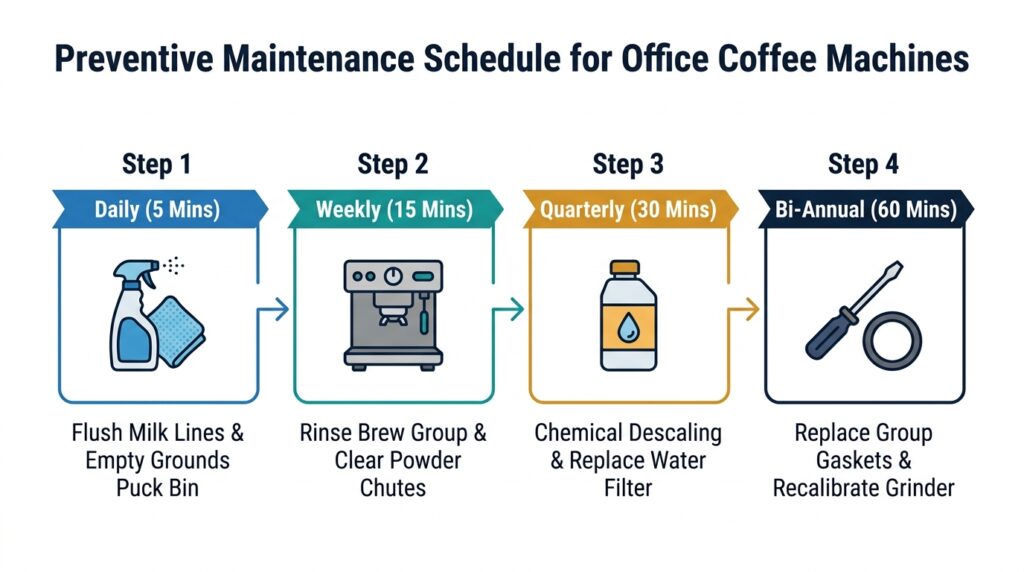
- Citric Acid Descaling Solutions: Dissolves limescale deposits inside boilers, thermoblocks, and internal solenoid valves.
- Alkaline Cleaning Tablets: Removes stubborn coffee oil buildup (caffeol) from espresso group heads and brew chambers.
- Milk System Flush Detergents: Breaks down milk fats and proteins inside automated frothing tubes and steam wands.
- Inline Carbon Block Water Filters: Removes chlorine, bad tastes, odors, and heavy metals while neutralizing scale-forming minerals.
Consistently maintaining your equipment requires a clear cleaning routine. Follow this complete coffee vending machine cleaning and maintenance guide to avoid service calls and extend equipment life.
Cost Per Cup Analysis and Budgeting Framework
A cost-per-cup framework calculates the total operational expense of brewing a single beverage by factoring in raw ingredients, paper disposables, machine depreciation, and preventive cleaning products. Establishing this benchmark helps financial teams accurately forecast monthly office beverage budgets.
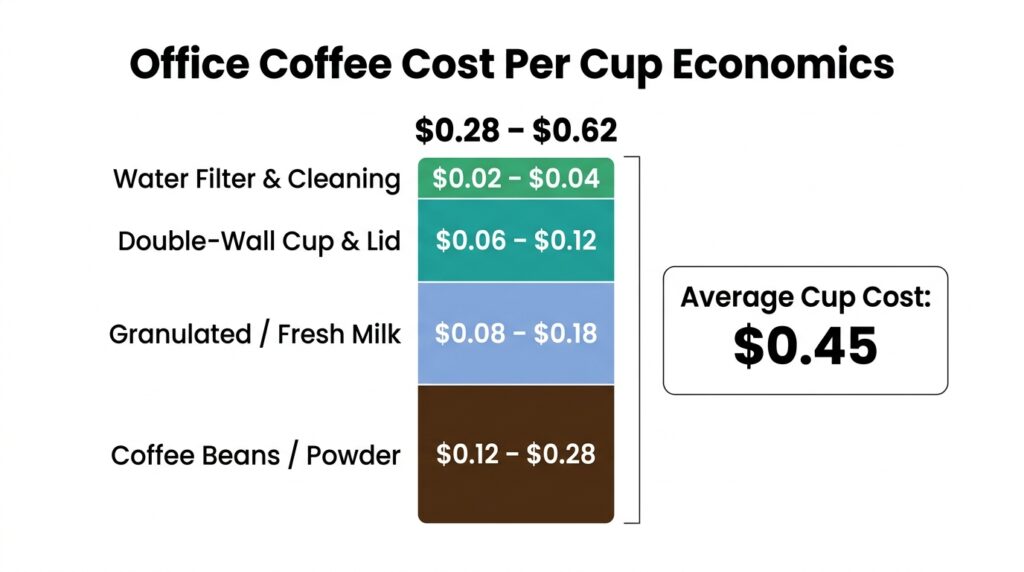
Financial Model: Instant Powders vs. Whole Bean Extraction
Ingredient selection creates significant variations in per-cup operating expenses across different equipment platforms.
| Cost Element | Soluble Powder Vending System | Bean-to-Cup Espresso System | Premium Single-Serve Pod System |
| Coffee Base Cost | $0.08 – $0.14 | $0.15 – $0.30 | $0.55 – $0.85 |
| Milk/Dairy Cost | $0.06 – $0.10 | $0.10 – $0.22 | $0.30 – $0.50 |
| Cup, Lid & Stirrer | $0.07 – $0.12 | $0.07 – $0.12 | $0.07 – $0.12 |
| Cleaning & Maintenance | $0.02 – $0.03 | $0.04 – $0.06 | $0.01 – $0.02 |
| Est. Total Per Cup | $0.23 – $0.39 | $0.36 – $0.70 | $0.93 – $1.49 |
Understanding these cost structures allows facility managers to budget accurately. Check this comprehensive coffee vending machine price guide to compare equipment costs against consumable expense projections.
Bulk Sourcing Strategies to Maximize Profitability
Bulk sourcing lowers per-unit costs by leveraging volume tier discounts, reducing shipping frequencies, and standardizing product specifications across multi-floor offices.
- Pallet-Level Ingredient Procurement: Buying whole beans and soluble powders by the pallet reduces wholesale ingredient expenses by 18% to 28%.
- Consolidated Disposables Shipping: Sourcing cups, lids, and stirrers from a single vendor cuts shipping fees and simplifies monthly accounts payable.
- Scheduled Auto-Fulfillment Contracts: Locking in annual supply agreements shields your organization from commodity coffee price fluctuations.
Calculating exact supply budgets is essential before purchasing hardware. Review this curated shortlist of the best office coffee machines to match your expected daily brew volume.
Vendor Selection Matrix: Direct Sourcing vs. Managed Services
Choosing between direct sourcing and a managed Office Coffee Service (OCS) contract determines whether your staff handles inventory reordering internally or relies on a third-party vendor. Both fulfillment models offer distinct trade-offs in labor, flexibility, and overall cost.
Wholesale Distribution Models
Direct wholesale purchasing involves buying ingredients and accessories directly from commercial roasters, ingredient manufacturers, or commercial distributors.
- Pros: Lowest per-unit cost, complete freedom to choose bean origins, no long-term vendor lock-in.
- Cons: Requires internal staff time to monitor inventory, restock canisters, and order replacement parts.
To streamline internal repairs when taking the direct sourcing route, source replacement components directly using this catalog of commercial coffee vending machine parts.
Managed Office Coffee Service (OCS) Contracts
Managed OCS contracts bundle equipment leasing, bi-weekly inventory replenishment, preventive servicing, and emergency repairs into a single monthly invoice.
- Pros: Hands-free breakroom management, guaranteed uptime, automatic restocks based on telemetry usage data.
- Cons: Premium per-unit pricing on ingredients, limited beverage vendor customization options.
For commercial locations that charge users per cup, adding modern cashless payment systems for coffee vending machines helps offset supply costs by capturing digital payments seamlessly.
Best Practices for Office Coffee Inventory Management
Efficient office coffee inventory management prevents stockouts, reduces ingredient spoilage, and optimizes cash flow. Applying lean inventory principles ensures fresh coffee and smooth daily breakroom operations.
Calculating Par Levels and Reorder Benchmarks
Establishing accurate par levels requires tracking your average daily cup consumption, factoring in vendor lead times, and maintaining a safety cushion for usage spikes.
Proper staff onboarding keeps machine operation smooth and reduces ingredient waste. Share this straightforward guide on how to use a coffee machine in office environments with your breakroom team.
Proper Storage Conditions for Coffee Beans and Dairy Powders
Environment controls prevent climate-induced degradation of whole beans and soluble powders during long-term breakroom storage.
- Temperature Control: Store all ingredients in a climate-controlled room between 60°F and 70°F (15°C to 21°C).
- Humidity Management: Maintain relative humidity levels below 50% to prevent milk powders and instant cocoa from clumping inside canisters.
- Elevation & Light: Keep supplies off the floor on stainless steel shelving units away from direct sunlight and heat-emitting appliances.
Before ordering equipment, verify physical breakroom space requirements using this guide to office coffee machine dimensions. Standardizing usage guidelines with a structured office coffee machine policy template further minimizes consumable waste across departments.
Providing quality workplace perks directly improves staff morale. Discover how upgrading breakroom amenities helps business growth in this study on how coffee machine helps in retaining employees. For additional sourcing frameworks, review this complete procurement checklist on how to find best office coffee machine for your office.
Frequently Asked Questions
How much coffee bean inventory should I order monthly for a 50-person office?
A 50-person office consuming an average of 1.5 cups per employee daily requires approximately 15 to 18 kilograms (33 to 40 lbs) of coffee beans per month. This estimate assumes a standard extraction dosage of 9 to 10 grams of whole bean coffee per single espresso shot.
What is the shelf life of agglomerated milk powder used in commercial coffee machines?
Unopened agglomerated milk powder packaged in nitrogen-sealed aluminum bags has a shelf life of 12 to 18 months when stored in a cool, dry area. Once poured into a machine canister, it should be consumed within 7 to 10 days to prevent moisture absorption and caking.
Why do oily coffee beans cause malfunctions in automated bean-to-cup machines?
Oily coffee beans leave heavy surface lipid deposits that stick to internal hopper walls, clog precision burr grinders, and bind fine coffee dust into stubborn sludge. Over time, these oily residues jam the internal brewing group and cause grinder motor failure.
What size paper cup is best for corporate coffee machine programs?
An 8oz to 10oz double-wall paper cup is ideal for corporate coffee setups because it comfortably accommodates single espresso shots, Americanos, and milk-based cappuccinos without overflowing. Double-wall construction eliminates the extra cost and mess of separate cardboard sleeves.
How often should office coffee machines undergo chemical descaling?
Office coffee machines should undergo chemical descaling every 1 to 3 months, depending on water hardness and daily brew volume. Using plumbed inline carbon-block water filtration systems slows scale accumulation and extends descaling intervals.
Can standard grocery store coffee beans be used in commercial office coffee machines?
Standard grocery store coffee beans can be used, but they are often unsuitable because mass-market dark roasts carry heavy surface oils that clog commercial grinders. Commercial-grade medium roasts engineered specifically for automated coffee platforms deliver better reliability and lower per-cup costs.
What is the difference between freeze-dried and spray-dried instant coffee powders?
Freeze-dried coffee powder is produced by freezing coffee extract and sublimation-drying it under a vacuum, which preserves volatile aromatic compounds and rich flavor profiles. Spray-dried coffee uses high-heat liquid atomization, resulting in a lower-cost powder with a flatter taste profile.
How do I stop milk powder from clogging commercial machine dispense nozzles?
Milk powder clumping is prevented by keeping the machine’s internal powder canisters completely dry, wiping steam dispense spouts daily, and maintaining ambient breakroom humidity below 50%. Setting automatic post-dispense steam purge cycles also keeps steam spouts clear of moisture.
Is it cheaper to lease an office coffee machine with supplies included or buy equipment outright?
Buying equipment outright lowers per-cup consumable costs by 30% to 45% because it frees you to negotiate wholesale ingredient pricing directly. Leasing with bundled supply agreements raises per-cup costs, but it eliminates upfront capital expenditure and includes hands-free maintenance.
What basic cleaning supplies are required for daily office coffee machine maintenance?
Daily office coffee machine maintenance requires milk line cleaning fluid, a group head cleaning brush, microfiber sanitation cloths, and automated cleaning tablets. Using dedicated commercial cleaning supplies prevents sour milk buildup and maintains beverage hygiene.